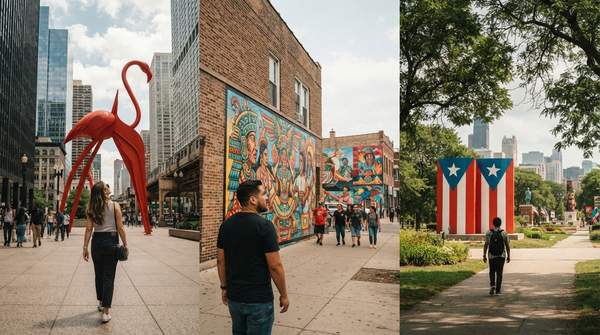
If you want monumental sculptures in an outdoor-museum setting, tour the Loop. If you want dense, colorful murals tied to Mexican culture, head to Pilsen. And if you want art that tells a specific community's political and cultural story, Humboldt Park's Puerto Rican murals and steel flags are the match. Here is how the three compare, and how to plan a self-guided visit to each.
The Loop: Monumental Sculptures and Urban Canvas
The Chicago Loop Alliance describes the Loop as functioning "like an outdoor museum," host to what it calls a stellar public art collection. Its guide is built to be used exactly the way a self-guided visitor would use it: as a tour of the Loop's "eye candies." That framing matters, because the collection is not clustered in a gallery but spread through the downtown streets and plazas, making walking the natural way to experience it.
The same organization also attributes real economic weight to the arts downtown, citing $2.25 billion in annual revenue that arts activity brings to the area and the city. For a visitor, the practical takeaway is simpler: this is a neighborhood where the art is the sidewalk-level scenery, and you take it in at your own pace.
Pilsen: Vibrant Murals and Community Expression
Choose Chicago, the city's official tourism body, sums up Pilsen's appeal in one line: "Explore vibrant street art, a diverse food scene, and a wealth of Mexican culture." That pairing is the reason to choose Pilsen over downtown. The murals and the Mexican cultural identity of the neighborhood are presented together, not as separate attractions, so a walking visit doubles as a food-and-culture outing.
What the tourism guide establishes is that the street art here is concentrated enough to be a defining neighborhood feature rather than scattered exceptions. Choose Chicago also profiles Humboldt Park with the same shorthand — "colorful murals, and Puerto Rican culture" — which hints at a useful split: Pilsen for Mexican cultural context, Humboldt Park for Puerto Rican.
Humboldt Park: Puerto Rican Identity Through Murals and Flags
Humboldt Park's public art carries the most explicit cultural mission of the three neighborhoods. The Chicago Sun-Times, reporting on the neighborhood's murals, described a decades-long project: muralists there have been trying to answer "what it means to be Puerto Rican in Chicago." The paper characterized the neighborhood as known for Puerto Rican pride and culture, and noted its murals are among the city's most controversial public art, rooted in political commentary on the community's struggles with police violence, displacement and self-determination, as well as Puerto Rico's struggles for sovereignty.
The Sun-Times highlighted one concrete example: Cristian Roldán's 2016 mural "Repression, Resistance and Resilience," which chronicles Puerto Rico's history and migration to Chicago, ending with the 1966 Division Street riots. Alongside the murals stand the Paseo Boricua steel flags, erected in 1995, which WTTW News reported received a "preliminary landmark recommendation" from the Chicago Landmarks Commission in early 2022. Choose Chicago notes the murals line a bustling cultural corridor, with history and heritage presented by lifelong resident Eduardo Arocho, founder of the Paseo Boricua Tour Company.